



Safeguarding
Keeping children and adults safe
Worth Valley Primary School is committed to safeguarding. Safeguarding means keeping your child happy, healthy and safe in school. All staff receive regular training and are aware of how to keep our pupils safe and what signs to look out for.
Our pupils are encouraged to share any concerns, and we have robust policies and processes in place that underpin safeguarding. We have a duty to report any concerns about pupils at Worth Valley, but we do not investigate them. We work alongside parents, carers and other agencies to keep our pupils safe.
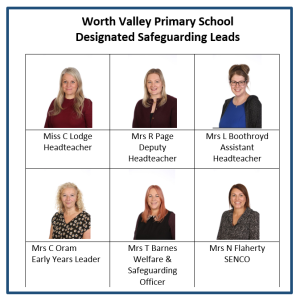
Our designated safeguarding leads
Child protection
In cases where the school has reason to be concerned that a child may be subject to ill- treatment, neglect or other forms of abuse, the Designated Safeguarding Lead may report this concern to Social Services and/or other appropriate agencies.
Please remember that when the school refers a concern about a child to the Social Services Department, it is not accusing the parents of abuse but requesting that further investigation takes place to establish whether a child is at risk.
Please find our safeguarding policies and guidance below.
WVPS Child protection and safeguarding policy 2025
Child friendly safeguarding policy
Safeguarding reporting flowchart
How we keep children safe
What we teach
We offer a secure and encouraging environment where children feel safe and their spiritual, moral and cultural development is enhanced through the delivery of our whole-school curriculum. This includes our PSHE and RE curriculum, core values and work with external agencies, charities and the local community. Online safety is taught through the computing curriculum and in PSHE lessons.
Recruitment
We carefully check that all staff and volunteers are safe to work with our children. A number of checks are carried out, including DBS checks, references, identification and employment history. We keep a single central record of this information, which is regularly monitored.
Visitors
Visitors and volunteers are rigorously checked in much the same way as staff before they can have any unsupervised access to our children. Any contractors on site must read the Safeguarding Information Leaflet before being signed into the building. All adults in school wear an ID badge.
All visitors to the school site are given a coloured lanyard. Red lanyards indicate that the visitor will not be interacting with children and children should not speak to them, for example, site contractors. Green lanyards indicate that the visitor is likely to interact with children around school and children can speak to these adults. All visitors wearing a green lanyard will have had their current DBS checked by the office staff on arrival.
Reporting a safeguarding concern
If you have concerns that a child is being harmed as a result of abuse or neglect, you must not keep these concerns to yourself.
Keeping children safe is everyone’s responsibility.
In the Bradford district, you can call the following numbers for advice or to make a referral:
- During office hours (8.30am–5.00pm Monday to Thursday and 8.30am–4.30pm on Friday), call the Children’s Social Services Initial Contact Point on 01274 437500.
- At all other times, call the Social Services Emergency Duty Team on 01274 431010.
- If you have reason to believe that a child is at immediate risk of harm, contact the police on 999.
- For all general enquiries, please contact Children’s Specialist Services on 01274 435600.
You need to ensure that you speak to the appropriate organisations, who can listen to and record your concerns and then take appropriate action.
Useful safeguarding links
Please find below a selection of useful websites offering further information, advice and support relating to safeguarding and keeping children safe.
Understanding consent
As part of our approach to safeguarding, we help children to develop an age-appropriate understanding of consent, personal boundaries and how to keep themselves safe. Please see our consent presentation below.